Showing posts with label dangue fever. Show all posts

Wednesday, September 21, 2011

Dengue 101-Dengue prevention tips?


Dengue Prevention Tips
Where heavy rainfall can mean fun, freshness and festivity; it can also turn into havoc if proper facilitation and preventive measures are not taken into account. Same has happened in Pakistan where dengue fever has hit the streets yet again claiming hundreds of innocent lives badly disturbing the normal course of life. As the saying goes “stitch in time saves nine, here are some preventive measures that everybody should follow to avoid the beat down by Aedes mosquitoes that cause dengue.
1. Remove sources of stagnant water.
Mosquitoes breed in stagnant water hence it is utterly important to not let the water accumulate. Make sure to:
 Turn pails and watering cans over and store them under shelter
 Remove water in plant pot plates. Clean and scrub the plate thoroughly to remove mosquito eggs. Avoid the use of plant pot plates, if possible.
 Cover overhead tank to prevent access to mosquitoes.
2. Avoid mosquito bites (by using mosquito repellents containing DEET, picaridin (KBR3023) or oil of lemon eucalyptus). Get your house and surroundings fumigated for pest control.
3. Prevent mosquito entry by keeping doors closed and windows screened.
 If your door and window screens have holes, there’s no better time to have them repaired.
4. Wear protective clothing like long-sleeved shirts, long pants, socks and shoes when outdoors.
5. Aedes mosquitoes usually bite during the day; therefore, special precautions should be taken during early morning hours before day break and in the late afternoon before dark.
6. Keep your house and surroundings clean. Make sure all the gutters are properly cleaned and covered.
7. There is no commercially available vaccine for dengue fever hence if symptoms for dengue occur such as:
• High-grade fever.
• Severe headache.
• Severe joint and muscle pain.
• Nausea and vomiting.
• Skin rash – The rash may appear over most of the body 3 to 4 days after fever.
• Bleeding from the nose, gums or under the skin, causing purplish bruises.
Make sure to contact your doctor immediately.
Remember that a safe home is a happy home. Keep yourself and the others around you safe and educate them about dengue prevention tips by sharing these tips.

Source: http://blogs.aaj.tv/2011/09/dengue-101-dengue-prevention-tips/

Wednesday, September 14, 2011

What are the Causes of Dengue?


There are four Dengue viruses (DENV) that cause Dengue fever, all of which are spread by a species of mosquito known as the Aedes aegypti mosquito, and more rarely by the Aedes albopictus mosquito. Aedes aegypti originated in Africa, but nowadays is found in all the tropical areas around the world and prospers in and close to areas of human population.

The high risk regions for catching dengue fever are Central America, South America, the Caribbean and tropical Asia; more specifically - northern Argentina, northern Australia, the entirety of Bangladesh, Barbados, Bolivia, Brazil, Cambodia, Costa Rica, Dominican Republic, Guatemala, Guyana, Honduras, India, Indonesia, Jamaica, Laos, Malaysia, Mexico, Micronesia, Pakistan, Panama, Paraguay, Philippines, Puerto Rico, Samoa, Singapore, Sri Lanka, Suriname, Taiwan, Thailand, Trinidad, Venezuela and Vietnam, and increasingly in southern China.

The virus is transmitted from an infected mosquito to human. The process begins when a person who is infected with the Dengue virus is bitten by a mosquito, the virus is then passed on when someone else is then bitten by the infected mosquito.

If you have suffered from dengue fever previously it is still possible to contract it again, because of the number of different types of viruses that cause the fever. If you were infected again and became ill, there is a greater risk of developing a harsher form of the disease, such as dengue hemorrhagic fever (particularly in children). This is unusual because, normally, previous exposure to a virus causes the body to carry antibodies that allow the body to fight off the virus more easily the second time.

article source: http://www.medicalnewstoday.com/articles/179471.php

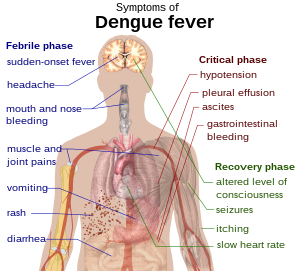
What are the signs and symptoms of Dengue Fever?


A symptom is something the patient feels or reports, while a sign is something that other people, including the doctor detects. A headache may be an example of a symptom, while a rash may be an example of a sign.

As there are different severities of dengue fever, the symptoms can vary.

Mild Dengue Fever - symptoms can appear up to seven days after the mosquito carrying the virus bites, and usually disappear after a week. This form of the disease hardly ever results in serious or fatal complications. The symptoms of mild dengue fever are:
  • Aching muscles and joints
  • Body rash that can disappear and then reappear
  • High fever
  • Intense headache
  • Pain behind the eyes
  • Vomiting and feeling nauseous
Dengue hemorrhagic fever (DHF) - symptoms during onset may be mild, but gradually worsen after a number of days. DHF can result in death if not treated in time. Mild dengue fever symptoms may occur in DHF, as well as the ones listed below:
  • Bleeding from your mouth/gums
  • Nosebleeds
  • Clammy skin
  • Considerably damaged lymph and blood vessels
  • Internal bleeding, which can result in black vomit and feces (stools)
  • Lower number of platelets in blood - these are the cells that help clot your blood
  • Sensitive stomach
  • Small blood spots under your skin
  • Weak pulse
Dengue shock syndrome - This is the worst form of dengue which can also result in death, again mild dengue fever symptoms may appear, but others likely to appear are:
  • Intense stomach pain
  • Disorientation
  • Sudden hypotension (fast drop in blood pressure)
  • Heavy bleeding
  • Regular vomiting
  • Blood vessels leaking fluid
  • Death
 source: http://www.medicalnewstoday.com/articles/179471.php